
-
Part 7: Aizawa Seishisai – Kokutai
This is part 7 of my series on Shinto as a civil religion, you can find the other parts here. The word Kokutai is translated to national politics or national structure. The term was first used by Aizawa Seishisai (1782-1863). He was a Confucian scholar of the Mito school, which focused on isolationism, nativism, and… Continue reading
-
Part 6: The Teachings of Hirata Atsutanes Kokugaku
This is part 6 of my series on Shinto as a civil religion, you can find the other parts here. The genre of Kokugaku which starts with Hirata Atsutane and his later followers Sato Nobuhiro and Okuni Takamasa would speak of “The Divine Age”. “The Divine Age” was a time when the Japanese lived after… Continue reading
-
Part 5: Kokugaku

This is part 5 of my series on Shinto as a civil religion, you can find the other parts here. Kokugaku, roughly translated as national teaching, was a kind of Japanese philology focusing on analyzing and philosophizing old Japanese texts, to return to a historical Japanese teaching. Phew! Before Kokugaku the study of Japanese history… Continue reading
-
Part 4: Shinto and its separation from Buddhism, 1868
This is part 4 of my series on Shinto as a civil religion, you can find the rest of the series here. Restoration Shinto’s influence on the new Meiji government was immediately evident when Shinto was successfully separated from Buddhism. A few months after the overthrowing of the shogunate, Okuni Takamasa, Fukuba Bisei, and Kamei… Continue reading
-
Part 3: The Meiji Restoration and Shinto

This is part 3 of my series on Shinto as a civil religion, you can find the other parts here. The Meiji Restoration was one of the biggest upheavals of Japanese culture in 200 years when it occurred in 1868. At the beginning of the 1800s, the Americans, the British and the Russians started to… Continue reading
-
Part 2: Shinto between 1600-1868
This is Part Two in my series on Shinto as a civil religion, which you can find here! Shinto between 1600-1868 (also known as the Tokugawa period), mainly existed in three different versions. All these were in relation to Buddhism. The most known about for many is the ritual practices of the Japanese Emperor and… Continue reading
-
Part 1: State Shinto as a civil religion – what is it?

I would like to start this first part of my series on Shinto with an apology! This post will be very heavy on the definitions. It might be a somewhat hard start to the series, but it is, unfortunately, necessary. To understand State Shinto, as is the focus of this series, we must understand civil… Continue reading
-
Part 0: Intro to my series on Shinto
I have always been fascinated by Shinto, so much so that I wrote my masters about it and its role in Japan during the years until World War II. This is the foundation for my new series on Shinto. And so I set out not only to translate the 75 pages into English but also… Continue reading
-
Review of Lesley Downer’s Women of the Pleasure Quarters
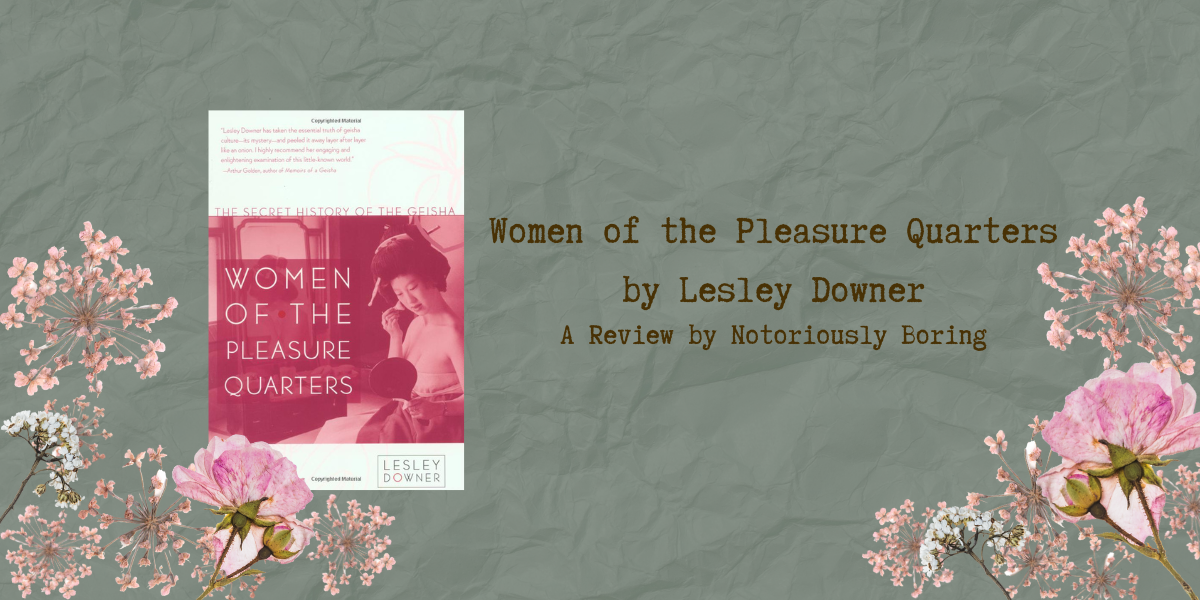
Overall Accessibility Fun Reliability Lesley Downer is a journalist (and historian, though she doesn’t mention whether she is educated or a hobbyist) with an interest in all things Japan. She has written many historical novels set in Japan, some of which I intend to review! Yet, as “Women of the Pleasure Quarters” is a testament… Continue reading
-
How do I review books?

I review books based on three factors, Accessibility, Fun and Reliability. And I realized it might not be obvious to everyone what these stand for, so here is a quick explanation! How I Review Accessibility Accessibility to me, is about how easily the text is to follow. If you’ve never ever read about this topic… Continue reading
Socials
About
My first experience with history, must have been my own story. I was tasked with mapping my family tree in school, and I remember so clearly the excitement and interest I had. Having my mom tell me the stories of the people who had come before me, and how they had lived so very differently then I had. I couldn’t get enough.
Recent Blog
- Part 30: State Shinto After the War
- Part 29: Summary of Kokutai no Hongi and Its Significance
- Part 28: Kokutai no Hongi – Harmony
- Part 27: Kokutai no Hongi – Loyalty and Patriotism
Recent Review
- Review of William D. Johnston’s Geisha, Harlot, Strangler, Star
- Review of Dr. Jan Bardsley’s Maiko Masquerade
- Review of Lesley Downer’s Women of the Pleasure Quarters
- Review of Liza Dalby’s Geisha